the locations guide
Where are the best places to renew your vows in Paris?
Choosing where to say it again is really two questions: which view you want behind you, and how many people are standing with you. A renewal, unlike an elopement, is often built around family, and family changes what a setting can hold. This guide walks nine settings couples ask for, with the honest practical detail the segment leaves out: when the light is yours, when the crowds arrive, and where the city asks for a permit.
N°01 · The settings
Which Paris settings suit a vow renewal?
Nine settings couples ask for by name, from the open landmarks that are yours only at dawn to the private ground that holds a group all day.
The Trocadéro
The most-requested setting, and the hardest to have to yourselves. The esplanade looks straight across the Seine at the Eiffel Tower, which is exactly why it fills. The tower itself admitted 6.3 million visitors in 2024 (SETE, the company that operates the monument for the City of Paris, January 2025), and the esplanade facing it is free and never closes, so it draws its own traffic from early morning on. It holds its quiet for roughly ninety minutes after sunrise; by mid-morning it belongs to the crowds. Two people at first light can stand there almost alone. A larger group cannot. The esplanade also closes for fashion-week structures in late February and September, when scaffolding goes up for a fortnight either side. For a renewal, it works best as a photograph before the ceremony, with the vows themselves held somewhere quieter close by.
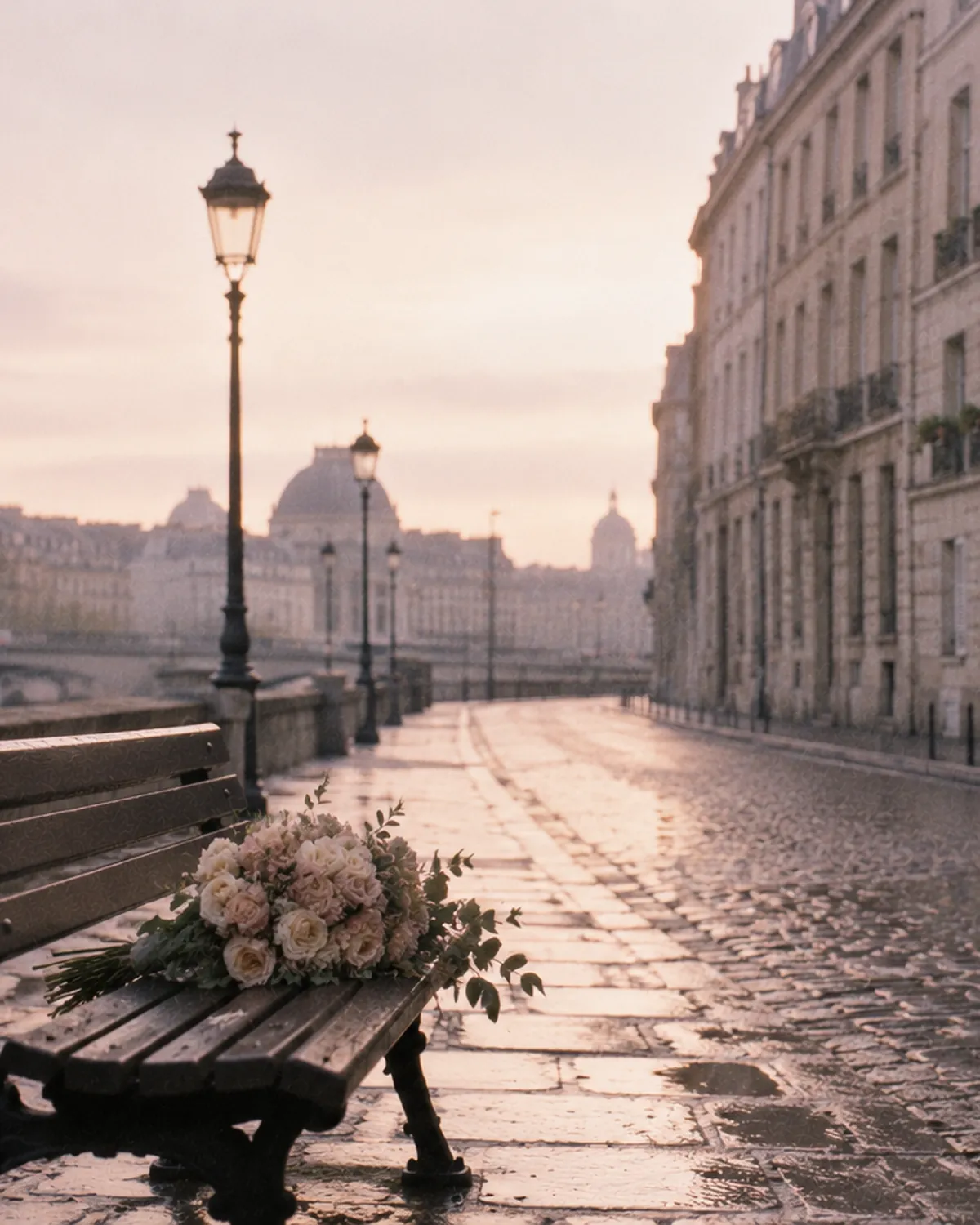
The Seine below the Eiffel Tower
Down at the river, the same tower view comes without the esplanade’s crowd. The Pont de Bir-Hakeim, with its two tiers and iron colonnade, is calm early and frames the tower on the diagonal; the quays below hold a couple and a few guests comfortably. This is the most private way to have the Eiffel Tower behind you. One practical point: the banks of the Seine are not open ground. A shoot with equipment on the quays is routed through the City’s AGATE authorization, filed fifteen working days ahead (Ville de Paris, 2026), which we handle for you. In winter the river is the strongest of the landmark settings: bare trees matter less by water, and the low light is even. First light, again, is the whole game.
The Jardin du Luxembourg
A garden reads differently from a landmark: enclosed, planted, made for standing still. The Luxembourg is managed by the French Senate, which opens the gates between 7:30 and 8:15 a.m. and shifts the hours fortnightly with the sun (jardin.senat.fr). That gate time matters for a dawn ceremony: you cannot be inside before it opens, so the Luxembourg suits a slightly later start than a riverbank does. The Médicis fountain, shaded and still, is the quietest corner; the terrace before the palace is open and holds a small group. Autumn is its season, when the chestnuts turn and the crowds thin. It is a natural choice for a renewal that includes children or grandparents: chairs, paths, shade, and somewhere to sit after.
The Jardin des Tuileries
Between the Louvre and the Place de la Concorde, the Tuileries is the oldest public garden in Paris and among the easiest to reach at an early hour. It falls under the administration of the Louvre and opens at 7 a.m., 7:30 in the winter months, free all year (louvre.fr). Its statues, basins and rows of green chairs give a ceremony structure without any decoration, which matters, because decoration is not permitted on public ground. In mid-April the flowering trees come pink for a few weeks; from late spring the garden is full and green. It is exposed, with little shade and busy by late morning, so the rule holds: arrive with the light, finish before the garden wakes.
The Louvre courtyards
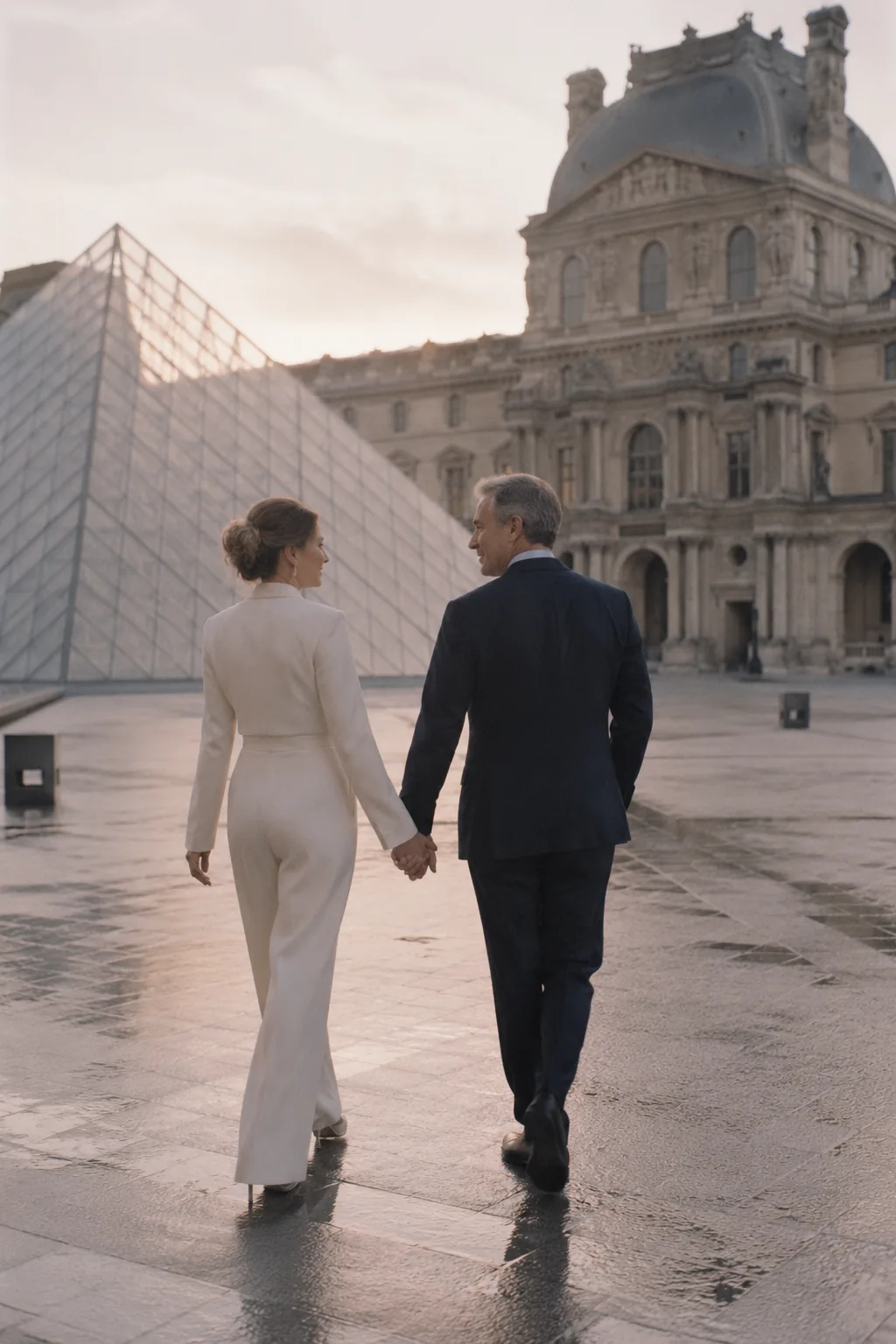
Behind the glass pyramid, the Cour Carrée is a stone courtyard most visitors walk straight past on their way to the galleries. It is enclosed, symmetrical and quiet early, its pale limestone photographing soft and warm, the blush register that suits a renewal without a single flower added. It works year-round, and it is one of the few landmark settings that holds up in winter, when the pyramid side is grey and thronged but the Cour Carrée stays still. The Louvre drew 8.7 million visitors in 2024, 77 percent of them from abroad (Musée du Louvre, January 2025); almost none cross this courtyard at dawn. Stand here first, then walk to the pyramid for a frame, not the other way round.
Parc Monceau
North of the centre, Parc Monceau is where Parisians take a renewal that wants greenery and no tourists at all. A colonnade curves around a small lake, a Renaissance-style bridge and scattered follies fill the paths, and by 8 a.m. it is mostly runners and residents. It photographs as a garden rather than a monument, which is the point for couples who have had their fill of landmarks. Spring through autumn is its window, when the planting is full; in winter it thins to bare structure. Like every Paris park, it is public ground: no arch, no petals, no amplified music, and a garden shoot with equipment goes through AGATE (Ville de Paris, 2026). For a quiet renewal with a handful of people, it is one of the calmest settings in the city.
The Palais-Royal
A few steps from the Louvre, the Palais-Royal is a courtyard of arcades and clipped limes, with Buren’s black-and-white columns at one end. It is enclosed on every side, which keeps it calm well after the open landmarks have filled, and the arcades give cover if the sky turns. The garden opens early and the light moves slowly across the gravel through the morning. It is central, so transfers are short for a group staying in the first arrondissements, and it reads as intimate on camera despite sitting in the middle of the city. As public ground, the same limits apply: no staging, and equipment via the City’s authorization. It is a strong fallback for the Tuileries, five minutes away.
A private hotel terrace with an Eiffel view
Everything changes on private ground. A hotel terrace can be booked ahead, decorated, and set to music, none of which is allowed in a public garden, and it holds a larger group than any landmark will. Terraces with an Eiffel Tower view, at addresses such as the Shangri-La or the Hôtel Raphael, are what couples choose when they want the city’s most famous backdrop and a real ceremony, with flowers and a table, in the same place. It removes the dawn constraint entirely: a private terrace is quiet at eleven as easily as at six. The trade is cost, and booking early, since there are few of them and they are asked for often. For a renewal with family and a meal after, this is usually the honest answer.
A château near Paris
For the largest gesture, a château outside the city privatizes the whole setting: grounds, salons, and the hours themselves. Some sit within forty minutes of Paris, close enough to photograph a landmark at dawn and hold the ceremony in the grounds by mid-morning. A château allows what public Paris cannot: a floral arch, a long table, a quartet, an evening that runs late. It suits a renewal built around the people who came. It is the top of the range and priced accordingly; our guide to how much a Paris vow renewal costs sets out what each level buys. Where public settings ask you to bend to the city’s hours and rules, a château bends to you. That is what you are paying for.
| Setting | Intimacy | Quiet window | Best season |
|---|---|---|---|
| The Trocadéro | Public | First light only | Spring, autumn |
| The Seine | Public | First light only | Winter, spring |
| Jardin du Luxembourg | Public | After the gates open | Autumn |
| Jardin des Tuileries | Public | First light only | Mid-April, spring |
| The Louvre courtyards | Public | Early, holds in winter | Year-round |
| Parc Monceau | Public | Early morning | Spring to autumn |
| The Palais-Royal | Public, enclosed | Holds after landmarks fill | Autumn, spring |
| Private hotel terrace | Private | All day | Any month |
| Château near Paris | Private | All day | Any month |
Public settings are quiet only at first light; private ones hold all day. Visitor scale: Musée du Louvre press release, January 2025 (8.7 million visitors in 2024). Season windows: Météo-France 1991-2020 normals.
N°02 · The calendar
When is the best time of year for a Paris vow renewal?
Season decides more than the photographs; it decides which settings are even worth choosing. A garden in February is bare structure, so a winter renewal leans on the stone settings: the Louvre courtyards, the Seine, a heated terrace indoors. Spring brings the Tuileries pink for a fortnight in mid-April and the parks back to green; early autumn turns the Luxembourg gold and empties the landmarks as the summer visitors leave. High summer is long and bright but hot and busy, which pushes everything to first light. Whatever the month, the weather is a passing-shower risk rather than a rainy season, and it is planned around rather than feared. The step-by-step in our guide to renewing your vows in Paris sets the timing out in full.
| Season | Best settings | Watch for |
|---|---|---|
| Spring (Apr to May) | Tuileries (pink trees ~mid-April), Luxembourg, Parc Monceau | Fashion-week structures at the Trocadéro into late Feb |
| Summer (Jun to Aug) | Seine, hotel terraces, château grounds | Heat and crowds: hold ceremonies at first light |
| Autumn (Sep to Oct) | Luxembourg (gold foliage), Louvre courtyards, Palais-Royal | Trocadéro fashion-week closures in September |
| Winter (Nov to Mar) | Louvre courtyards, Seine, private terraces (indoor) | Bare gardens: plan a covered setting |
N°03 · The city’s rules
Do you need a permit to renew your vows in a Paris park or garden?
Two things are worth knowing before you settle on a place. First, the light-shoot route is narrow: a team of up to ten people, lightweight equipment, streets and bridges only, no vehicles. A celebrant, a couple and one photographer usually sit well inside it; a garden, a quay or a film crew does not, and those go to AGATE three weeks ahead (Ville de Paris, 2026). Second, and this surprises couples, the best-known landmarks are not administered by the City’s film office at all. The Eiffel Tower, the Louvre, the Tuileries and the Luxembourg each answer to their own site manager, and requests go to them directly. Rules differ by site and they change. We confirm each case before your date rather than assume, and where an authorization is needed, we file it.
N°04 · Public or private
Public setting or private venue: which is right for you?
This is where a renewal parts company with an elopement. An elopement is built for two, and two people fit anywhere in Paris at dawn. A renewal is often built for the people who have watched a marriage hold: children, grandchildren, a few close friends. A group of eight moves at half the speed of a couple, draws attention on public ground, and cannot legally have an arch, a sound system or a champagne table on a Trocadéro esplanade or in a garden. None of that makes a public setting wrong. It makes it a decision about scale. Small and early, the city is yours for the price of a permit. Larger, or later, or set to music, and a private terrace or château stops being a splurge and becomes the only setting that holds the day you are describing. If the two of you are eloping rather than renewing vows, the settings differ: see the best places to elope in Paris.
N°05 · Questions
Paris vow renewal locations: common questions
What is the most popular place to renew your vows in Paris?
The Trocadéro, for its head-on Eiffel Tower view, followed by the Seine quays just below it. Both are public and busiest by mid-morning, so couples take them at first light and hold the ceremony itself in a quieter garden or on a private terrace nearby.
Can you renew your vows at the Eiffel Tower?
You can stand within sight of it, at the Trocadéro or on the Seine, and couples do. The tower and its immediate setting are not administered by the City’s film office, so any request involving equipment goes to the site’s own management (Ville de Paris, 2026). We confirm what each spot allows for your date.
Can you have a vow renewal with flowers and music in a Paris park?
No. Public parks and gardens do not permit staging, floral arches, petals, tables or amplified music, and a shoot with equipment needs an AGATE authorization. For flowers, a table and music in one place, the setting is a private hotel terrace or a château, both booked in advance.
When is it quietest at these locations?
The landmark settings hold their calm for roughly ninety minutes after sunrise and then fill. The Louvre drew 8.7 million visitors in 2024 (Musée du Louvre, January 2025), and they do not arrive evenly. First light is the only reliable way to have a public setting to yourselves.
Can our children and guests attend at these locations?
Yes, and a renewal is often built around them. A handful of people fit a public garden at dawn; a larger group needs a private venue, which also removes the early-start constraint. Tell us who is coming before you choose where to stand. It changes the setting more than the view does.
Which location is best in winter?
The stone settings: the Louvre courtyards, the Seine, and private terraces used indoors. Gardens go bare from November, so a winter renewal leans on architecture and water rather than planting, and a covered fallback is part of the plan (Météo-France, 1991-2020 normals).
Tell us the moment.We’ll design the rest.
One contact, from the first email to the morning itself. We stay neutral, match you with the right people, and hold the day, including the permit, the timing, and the setting that fits your number. See how the whole of it is planned on our Paris vow renewal page.